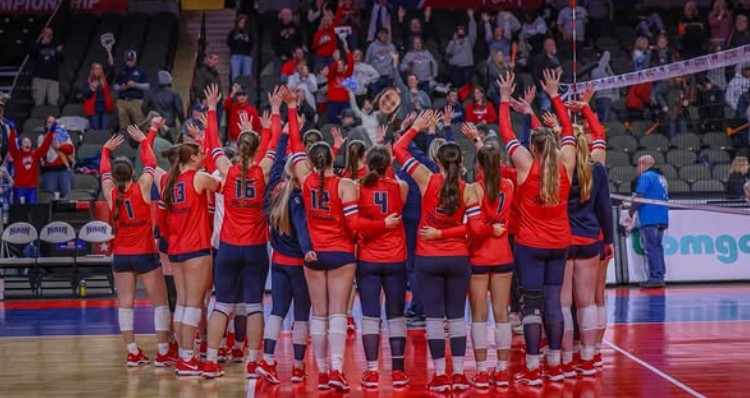
Two matches, six sets, none dropped. That’s the headline out of West Palm Beach, and it’s a good one the tenth-ranked Patriots opened the 2026 season by handling Goshen College and Texas Wesleyan on the same day and advancing to the gold bracket at the Keiser Invitational.
Savanah Jolly also picked up her 2,000th career assist along the way, in a match where she set nearly the entire offense.
The box scores tell a more complicated story than the sweeps do. Here’s what actually happened.
Jolly hits 2,000, and the offense changes hands
Savanah Jolly recorded the 2,000th assist of her career against Texas Wesleyan. It came in the right match. She finished with 29 assists, and Cumberlands scored 39 kills as a team, meaning Jolly set roughly three of every four balls the Patriots put away.
Two thousand assists is a career built one touch at a time by a player whose job is to make everyone else’s numbers look good. Bryant’s 31 kills across two matches don’t happen without someone delivering the ball where she can hit it. Most of the second match, that was Jolly.
The milestone also landed on the night the offense visibly changed hands.
Against Goshen, Morgan Bentel ran the set with 18 assists to Jolly’s 6. Against Texas Wesleyan four hours later, that reversed almost completely: Jolly 29, Bentel 2.
That’s not a substitution pattern. That’s a different system.
Bentel didn’t disappear, though. Her dig total went from 4 against Goshen to 17 against Texas Wesleyan, the highest on the team by a wide margin. She moved from running the offense to anchoring the back row, and she was excellent at it.
Whether this is a planned two-system season or an in-tournament adjustment is the thing worth watching. Either way, both lineups won.
Efficiency dropped, and not only because the opponent improved
The Patriots hit .479 against Goshen. Against Texas Wesleyan they hit .269.
Attack errors tell the same story more bluntly: 5 in match one, 14 in match two. Total attacks went up, from 71 to 93, so they were swinging more often and connecting less. Some of that is simply that Texas Wesleyan is the better team. Goshen hit .075 for the match and never led after the opening point of the third set. That’s a team getting overrun.
Texas Wesleyan made Cumberlands earn it. The Rams hit .346 in the third set and dug 38 balls on the night.
The scoreboard flattered the second match
A 3-0 line suggests a comfortable evening. The set-by-set says otherwise.
Set two was tied at 20 before Cumberlands closed it 25-21. Set three was tied at 22 before three straight points ended the match. The Patriots trailed or were level late in two of three sets against a team they eventually swept.
That’s not a criticism. Winning tight sets is a skill, and they won all of them. But a sweep that includes two 22-plus finishes is a different result from one that includes a 25-10.
Brynnley Bryant is carrying an enormous load
Bryant took 41% of the team’s swings in match one and 41% again in match two. Across both matches: 31 kills, 68 attempts, 35.5 points.
Match one was spectacular 14 kills, .367 hitting. Match two was heavier: 17 kills, but 9 errors and a .211 clip on 38 attempts. She also passed 12 balls, dug 7, and put up 2 total blocks in that second match.
Two things are true at once. Bryant was the best player on the floor in both matches. And a team that funnels 40% of its offense through one outside hitter, while also asking her to pass and defend, is asking a lot of one player on day one of a season with a gold bracket still ahead.
The secondary attack needs to hold up
Sara Zampedri hit .444 on 18 swings against Goshen. Against Texas Wesleyan: .158 on 19 swings. Nearly identical volume, less than half the efficiency.
Elaina Fischer picked up some of the slack with 6 kills on .308 hitting, and Martina Frangella was quietly efficient at .600 on 5 attempts. But when Zampedri isn’t scoring, the offense narrows, and a good block can start sitting on Bryant.
Serving is aggressive to the point of breaking even
Across both matches: 16 service aces, 21 service errors.
That’s a deliberate philosophy, not sloppiness, you don’t accumulate 16 aces on day one by playing it safe. It worked against Goshen, where 9 aces against a shaky passing team helped break the match open. Against Texas Wesleyan it was closer to a wash: 7 aces, 10 errors.
Against peer competition, that ratio has to improve or the free points start flowing the other way.
Our take
This was a good day. Six sets, no losses, a career milestone for a four-year setter, and a spot in the gold bracket. Nobody should read the notes above as concern trolling a 2-0 start.
But the interesting stuff in a season opener is rarely the final score. It’s the two-setter question, whether the second and third attacking options can carry more, and how much of the offense a healthy Bryant should be asked to hold. Day one raised those questions. It didn’t answer them.
The numbers
| vs Goshen | vs Texas Wesleyan | |
|---|---|---|
| Result | W 3-0 (25-17, 25-13, 25-10) | W 3-0 (25-18, 25-21, 25-22) |
| Hitting % | .479 | .269 |
| Kills | 39 | 39 |
| Attack errors | 5 | 14 |
| Total attacks | 71 | 93 |
| Assists | 35 | 39 |
| Aces / errors | 9 / 11 | 7 / 10 |
| Digs | 27 | 49 |
| Bryant | 14 K, .367 | 17 K, .211 |
| Lead setter | Bentel (18) | Jolly (29) |