The Patriots open Friday night against Simmons, and the frontcourt that takes the floor will look familiar. The backcourt will not.
Six players return from a 25-8 team. They bring back 65% of the blocks, 49% of the rebounds, and the two most efficient interior players on the roster. They also bring back 37% of the three-point shooting on a team that made 10.1 threes a game, because the two men who took most of those shots are gone.
 The story so far
Twenty-five and eight, and the first thing to do with that number is split it. Five of those games were postseason. The regular season was 22-6. The postseason was 3-2: a win over Cumberland and an overtime loss to Bethel in the Mid-South tournament, then two home wins in the NAIA opening round before Grace ended it in the round of 16.
The second thing to do is look at where the dominance went.
Overall scoring margin was plus 11.5 a game. In conference play it was plus 2.4. UC went 7-5 in the Mid-South, and the shooting is where it slipped: opponents hit .396 from three against them in league games while UC made .332 of its own. Over twelve conference games, opponents also outassisted them 169 to 154.
Home was close to untouchable at 13-1. The road was 7-5, and conference road games were 2-4.
 What comes back
Javecckio Thomas is the anchor and the most complete returning player on the roster. As a redshirt junior he scored 371 points on .502 shooting, pulled 195 rebounds, handed out 69 assists, and blocked 34 shots across 27.2 minutes a night. He was steady in league play too, at 10.7 a game with 5.3 rebounds.
Brant Smithers is the shooting that survived. He made 85 threes at .397 and scored 388 points while starting only six of 33 games, and he was better when it counted: 12.3 a game in conference play on .408 from deep.
Malachi Robinson blocked 36 shots, more than anyone on the roster, and shot .493 from the floor as a freshman. The number begging for a sophomore jump is at the line, where he made .396 of 91 attempts. Fix that and his scoring changes shape entirely.
Tanner Walton is the efficiency curiosity. He shot .548 from the field and .486 from three, with 77 assists against 23 turnovers, and did all of it in 17.8 minutes across 33 games without a single start.
Abraham Ibezimakor at 6-9 and Julian Miles round out the group with limited minutes.

 What is actually gone
Kyle Duke scored 653 points, 20.4 a game, on .474 from the field, .426 from three on 155 attempts, and .879 from the line. He added 83 assists. In conference play he was exactly the same player, 20.4 a game on .393 from deep.
Andrew McConnell added 432 points and 81 threes at .388 across 31 starts.
Between them that is 1,085 points, or 38.4% of everything UC scored, and 147 of the team’s 333 made threes, or 44.1%. For a team built on volume from the perimeter, losing both high-usage shooters in the same offseason is the defining fact of this roster.
Anthony Harris leaves more quietly and is underrated in the leaving: 219 points on .573 shooting with 131 rebounds and 23 blocks. Brady Bell started all 33 games but shot .331 from the field and .257 from three, so those minutes are an opportunity rather than a loss.
 What came in
Seven newcomers, and unlike the women’s roster this is a transfer class rather than a freshman class.
Kedar Bodie arrives as a senior guard from North Alabama and Trey Johnson as a senior guard from LSU-Shreveport, both from four-year programs. Tajahri Cave, a senior guard out of Toronto, comes from Langston, which opened last season ranked near the top of the national poll. Jhamien Smith is a 6-7 junior forward from Holmes CC and Iago Stanback a sophomore guard from Lawson State CC. Kendall Phillips and Zubin Davidson fill out the roster behind them.
Four veteran guards brought in to replace two veteran guards. Matt Daniel went shopping for exactly what walked out.
 How we think it starts

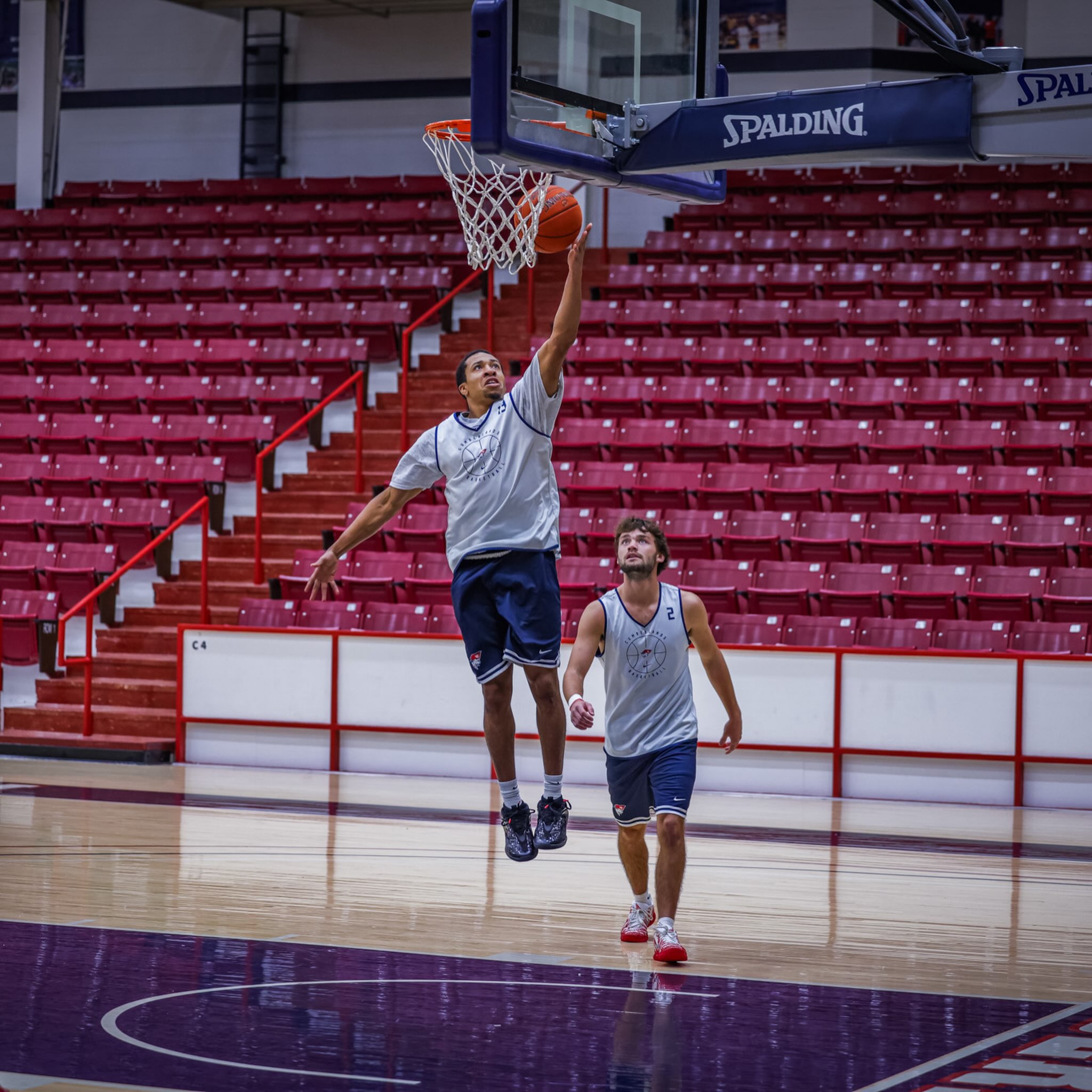
Preseason work at the O. Wayne Rollins Center.
Our expectation is a slow start, and we do not mean that as a warning.
With this many new faces, the first half of the season should produce flashes of what this group could be without much consistency behind them. A big night from the new backcourt, then a flat one. A stretch where the spacing looks right, then three possessions where nobody knows who is cutting. That is what a roster with four new guards looks like in November.
The second half is where we expect that to change. The more these players log minutes together, the more the chemistry catches up to the talent, and we think the version of this team that shows up in February is substantially better than the one that opens against Simmons. Four new guards sharing a backcourt is exactly the situation where talent arrives before timing does.
 The calendar problem
Here is the tension nobody in the program can schedule their way out of.
The slow build makes sense. The second half of the season is where this group expects to be whole. But the second half of this particular schedule opens with the hardest stretch on it.
After hosting Freed-Hardeman on January 7, UC plays four of its next five on the road: Lindsey Wilson on the 9th, Campbellsville on the 14th, Cumberland on the 16th, and Georgetown on the 23rd, with only Bethel at home in between. That is three road games in eight days to start league play.
This team went 2-4 in conference road games last season with Duke and McConnell on the floor. The chemistry has to arrive before the road trip does, not after it.

The good news is November hands them the runway to do it. Seven of the first nine games are at home or on neutral floors, and the non-conference slate is mostly manageable. Pikeville, who beat UC 86-80 last December, is the first real test on November 3. Georgia Gwinnett in December and Keiser in Florida are the other two away games with teeth.
Thirteen of the 28 games are at the Rollins Center, where UC went 13-1.
 Our take
21-7 in the regular season, 8-4 in the Mid-South.
Non-conference should come in around 13-3. The home schedule is soft enough that a veteran roster handles it, with Pikeville, Keiser, and Georgia Gwinnett as the likely stumbles.
Eight and four in conference is the call we went back and forth on the longest, because it asks this team to be better in league play than it was with Duke and McConnell on the floor. Here is why we think it gets there.
Last season UC went 5-1 in conference home games and 2-4 on the road. The home number is not the problem and never has been. Eight and four means going roughly 5-1 at the Rollins again and finding one more win away from it, and the roster is built to do exactly that. Four veteran guards who have played real minutes at four-year programs are a different proposition in a hostile gym than a rotation leaning on underclassmen, and the minutes that opened up are Brady Bell’s, who started all 33 games while shooting .331 from the floor and .257 from three. Replacing those possessions with anything average is an upgrade.
Add 65% of the blocks and the two best interior finishers returning, and the defensive floor holds while the backcourt sorts itself out.
What we believe is that the shape of this season will be exactly what the program described. Expect November to look uneven in a way that worries people who only read scores, and expect this team to be better in February than it is in December. The danger is that the calendar does not reward patience, and a 1-4 start in league play digs a hole that a strong finish can only partly fill.
One game off last season’s 22-6, with a better conference record inside it, is our read. This group should still be hosting an opening round in March, and if the backcourt comes together faster than expected, the ceiling is higher than this projection gives them credit for.

The Patriots open Friday at 7 against Simmons College of Kentucky at the Rollins Center.
Win-loss projection and the opinions in “Our take” are this publication’s own. Statistics via the 2025-26 University of the Cumberlands season statistics report (final, March 20, 2026), the 2026-27 roster, and the 2026-27 schedule.